Post-Concussion Concerns · Calgary
A Concussion Can
Affect More Than
Your Brain
A concussion is a brain injury. But the force that affects the brain can also place significant stress on the neck. Headache, dizziness, balance problems and neck pain can have both neurological and cervical contributors.
Dr. Cody Gordon evaluates the upper cervical spine — where the skull, atlas (C1) and axis (C2) meet — to determine whether dysfunction in the neck may be another piece of the post-concussion picture.
Calgary, Alberta
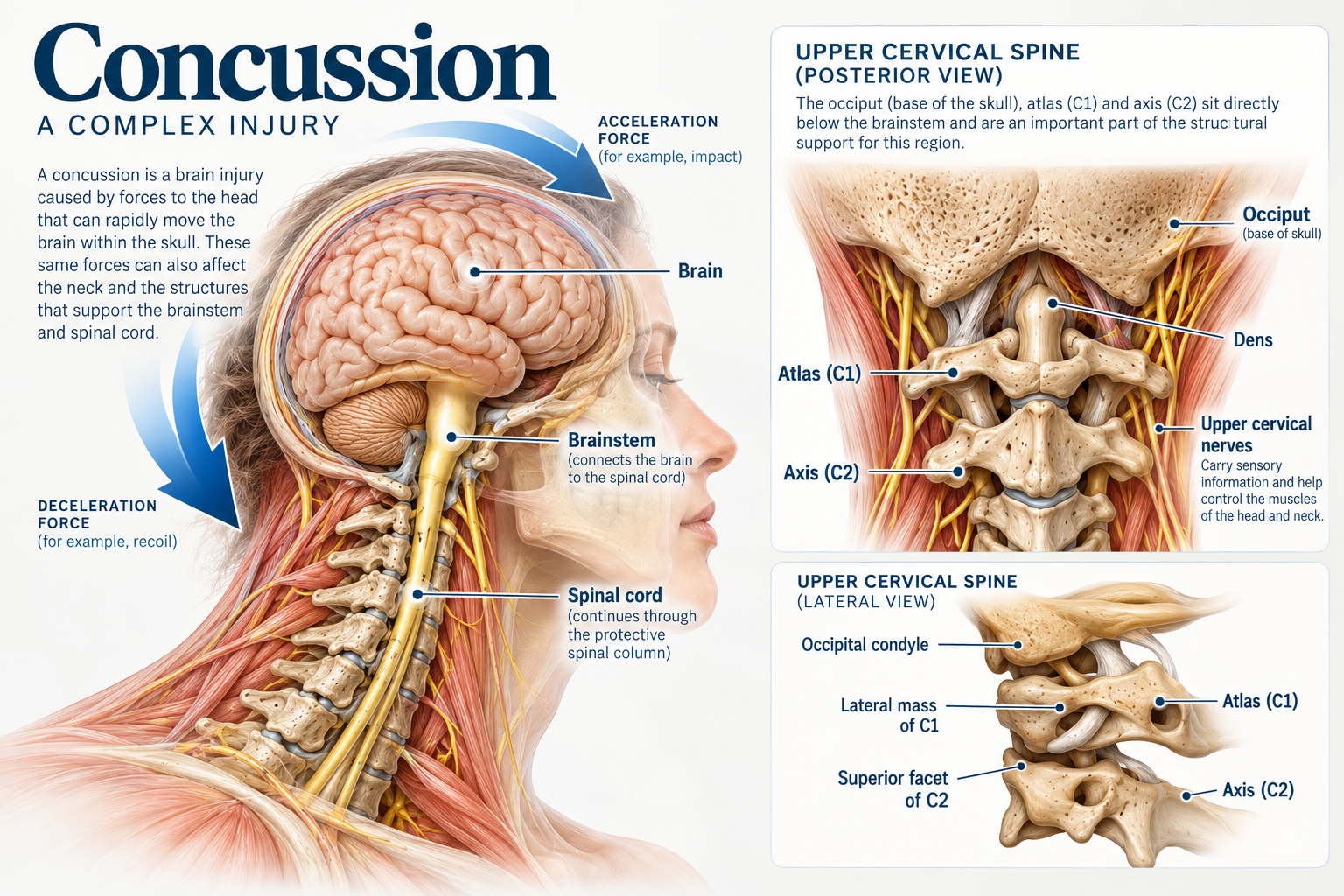
The Concussion–Neck Connection
When the Brain Is Injured, Don't Overlook the Neck
A concussion can change someone's life in an instant. And when symptoms linger, people often spend months searching for an explanation for why they still don't feel like themselves.
One area that deserves a very close look is the upper cervical spine.
Think about the injury itself. The force that accelerated, decelerated or moved the head strongly enough to produce a concussion also travelled through the neck that supports it. The brain and cervical spine didn't experience two separate events. They experienced the same event.
This becomes especially important when symptoms such as headache, dizziness, balance disturbance, neck pain, stiffness or difficulty tolerating movement continue after the initial injury.
At the base of the skull is one of the most remarkable areas of the human body. The brainstem transitions into the spinal cord, which continues through the protective spinal canal. Surrounding this region are the occiput, atlas (C1) and axis (C2), along with an intricate system of joints, muscles, ligaments, nerves and sensory receptors.
The upper neck also provides the brain with a constant stream of information about head position and movement. That makes the relationship between the head and upper cervical spine particularly important when evaluating someone who continues to struggle following a concussion.
If you're still struggling after a concussion, your upper neck may be an important part of the picture that hasn't been fully investigated.
Video: Dr. Gordon Explains Why the Upper Neck Matters After Concussion
A Highly Specific Upper Cervical Approach
Why Dr. Gordon Looks So Closely at C1 and C2
For more than two decades, Dr. Cody Gordon has focused much of his clinical work on the upper cervical spine and the unique relationship between the head, atlas and axis.
These aren't ordinary vertebrae. C1 and C2 are shaped differently from the rest of the spine and are responsible for an extraordinary amount of the head's movement. Their position directly beneath the skull places them at the centre of the mechanical relationship between the head and neck.
NUCCA allows Dr. Gordon to examine this region with a level of specificity that is very different from simply treating a tight or painful neck.
He looks carefully at the relationship between the head and upper cervical spine, the mechanics of the region and the patterns of compensation that can develop throughout the neck and body.
When an upper cervical problem is identified, NUCCA uses a gentle, precise correction designed to improve alignment and mechanics without twisting or forceful manipulation of the neck.
The goal is to create the best possible mechanical environment for this important region — reducing unnecessary stress, improving how the upper neck functions and giving the body the best opportunity to move forward.
For someone who has already tried multiple approaches yet continues to struggle, taking a closer look at the upper cervical spine can open an important new avenue to explore.
If your concussion was months ago but you still don't feel like yourself, ask one more question:
“Has anyone taken a really close look at my upper neck?”
A consultation with Dr. Gordon is an opportunity to tell your story, have this region carefully evaluated and find out whether upper cervical care deserves to be part of your next step.
Book a Consultation →