When Your Joints
Are More Mobile,
Precision Matters
Living with Ehlers-Danlos syndrome or significant hypermobility can make finding the right care especially challenging. When your joints are already more mobile than average, the last thing you want is a treatment that leaves you feeling worse.
With more than two decades of experience, Dr. Cody Gordon provides gentle, highly specific NUCCA upper cervical care. His approach focuses on carefully evaluating the relationship between the skull, atlas (C1), and axis (C2), while considering your individual concerns about joint stability and previous treatment experiences.
Calgary, Alberta
A Different Kind of Neck
Deserves a Different Approach
Ehlers-Danlos syndromes are a group of connective-tissue disorders. In hypermobile EDS and related hypermobility disorders, increased joint mobility can create a different mechanical environment than we see in the average spine.
That distinction matters.
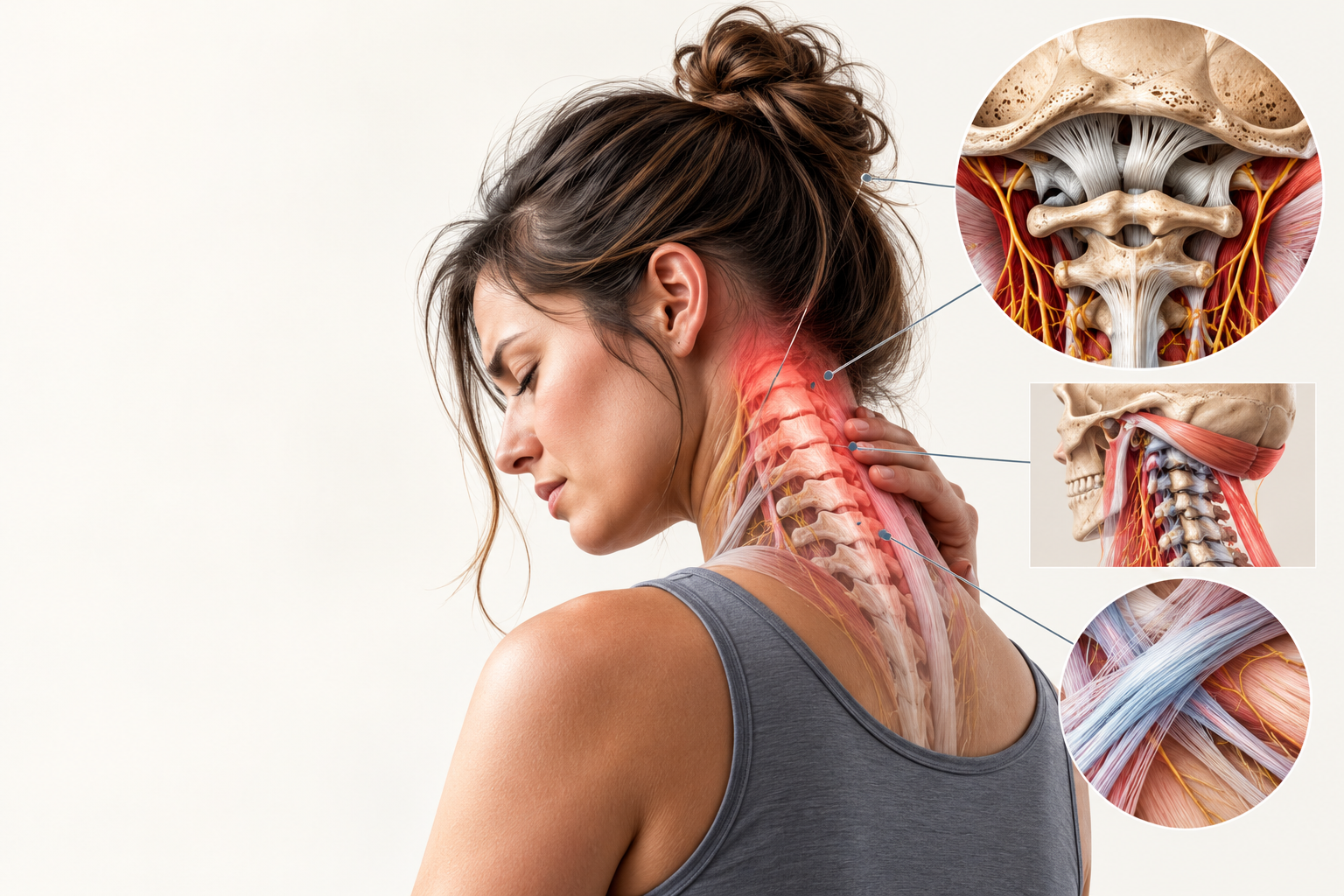
The cervical spine depends on a complex system of joints, ligaments, muscles and neurological feedback to support the head and control movement. When the tissues that contribute to joint stability are more lax, the surrounding muscles may have to work harder to maintain control.
Some people with hypermobility experience neck pain, headaches, dizziness, muscle tension, feelings of instability, or difficulty tolerating certain neck positions and movements. These symptoms can have different causes and deserve careful evaluation.
At the very top of the neck are the occiput, atlas (C1) and axis (C2). This region plays an important role in movement and positioning of the head.
When neck-related symptoms persist, a careful, highly specific upper cervical assessment may help determine whether a mechanical issue in this region deserves further attention.
You've Been Through Enough. It's Understandable to Be Cautious.
If you've tried treatments that didn't help, or treatments that made you feel worse, you may be understandably hesitant to try something new. You deserve to have those experiences taken seriously and to understand exactly what is being considered before any treatment begins.
Gentle Is Important.
But Gentle Alone Isn't Enough.
If you live with Ehlers-Danlos syndrome or significant hypermobility, you've probably been told to look for gentle treatments. And that advice makes sense.
But there's an important distinction that often gets overlooked: a treatment can be gentle without necessarily being specific to the problem you're trying to address.
A gentle massage, stretching technique, or other low-force treatment may have its place. But gentleness alone doesn't tell us whether the treatment is directed toward an identified mechanical concern.
When it comes to your neck, you deserve care that's both gentle and specific.
This is one of the defining principles behind Dr. Gordon's NUCCA approach. Rather than simply applying a gentle treatment to the neck, he begins by evaluating whether there is a specific upper cervical mechanical concern that may be appropriate to address.
If care is indicated, the objective is to use a carefully planned, low-force correction directed toward that identified concern — not to mobilize joints that may already have excessive movement.
Gentle
A low-force approach without the traditional twisting, cracking, or forceful manipulation of the neck.
Specific
An assessment focused on the relationship between the skull, atlas (C1), and axis (C2), rather than a generalized treatment of the neck.
Purposeful
A clear clinical reason for considering care, with decisions guided by individual findings, history, and tolerance.
Concerned About Neck Instability?
So Are We.
For people living with Ehlers-Danlos syndrome, concerns about cervical instability deserve to be taken seriously.
Increased joint mobility and connective-tissue laxity can change how the neck responds to positioning, movement, and treatment. Dr. Gordon considers these factors before recommending upper cervical care.
His approach is not simply to use less force. It is to carefully consider what should be assessed, what should be avoided, and whether an upper cervical correction is appropriate at all.
No Unnecessary Joint Mobilization
For patients with significant hypermobility, Dr. Gordon avoids spinal joint mobilization and forceful neck manipulation. His NUCCA approach does not aim to increase movement in joints that may already be excessively mobile.
Careful Positioning and Support
Patient positioning and comfort are important. When appropriate, Dr. Gordon uses a customized, supportive headpiece and adapts positioning to individual tolerance and clinical findings.
Assessment for Possible Instability
A careful history and examination help guide decisions. When clinically indicated, specialized cervical X-rays, including lateral-flexion open-mouth views, may provide additional information about upper cervical alignment and movement. Imaging findings are considered alongside the broader clinical picture.
Decisions Made Case by Case
Not every patient with EDS is a candidate for upper cervical correction. When instability is suspected or identified, Dr. Gordon considers whether care should be modified, deferred, or whether further medical evaluation is appropriate.
These considerations are particularly important for patients who have previously experienced discomfort or symptom aggravation with stretching, massage, manipulation, or other neck treatments.
The goal is not to apply the same procedure to every patient. It is to understand your particular situation and determine whether there is a reasonable, appropriately cautious role for upper cervical care.
Your history matters. Your concerns matter. And the decision to proceed with care should be based on your individual findings.
When There Is More Mobility,
More Force Isn't the Goal
Ehlers-Danlos syndrome affects connective tissues throughout the body. While upper cervical care does not change the underlying connective-tissue condition, having EDS does not mean that every neck problem must automatically be attributed to it.
A person can have hypermobility and a separate cervical mechanical problem. Recognizing that possibility is an important part of Dr. Gordon's approach.
NUCCA upper cervical care focuses on the relationship between the head, atlas (C1), and axis (C2). Through a detailed assessment, Dr. Gordon looks for findings that may indicate an upper cervical mechanical concern worth addressing.
The objective is not to create additional movement in an already mobile neck. It is to determine whether a specific mechanical issue exists and whether addressing it would be appropriate for that individual.
Could dysfunction involving the cervical or upper cervical spine be another piece of what you're experiencing?
That's the question Dr. Gordon is trying to answer.
When an upper cervical concern is identified, the next step is to consider whether NUCCA care is appropriate, taking into account your medical history, examination findings, joint stability, and individual circumstances.
For some patients, upper cervical care may be one part of a broader approach that includes their other healthcare providers.
Start With a Conversation,
Not a Commitment.
If you're living with Ehlers-Danlos syndrome or significant hypermobility and have been struggling with neck-related concerns, you don't have to decide about treatment before speaking with Dr. Gordon.
Book a free 15-minute consultation to discuss your history, your concerns, and your previous experiences with care. It's an opportunity to ask questions, learn more about Dr. Gordon's NUCCA approach, and explore whether a more detailed upper cervical evaluation may be appropriate.
No treatment during your consultation. No pressure to proceed. Just an opportunity to have your questions answered and decide on your next step.