Migraine & Headaches · Calgary
Could Your Neck Be
Part of the Picture?
Migraine and headaches can have many different causes. For some people, dysfunction in the upper cervical spine may be one part of the clinical picture. Dr. Cody Gordon assesses the relationship between the head and upper neck to determine whether this region may be relevant to your symptoms.
Calgary, Alberta
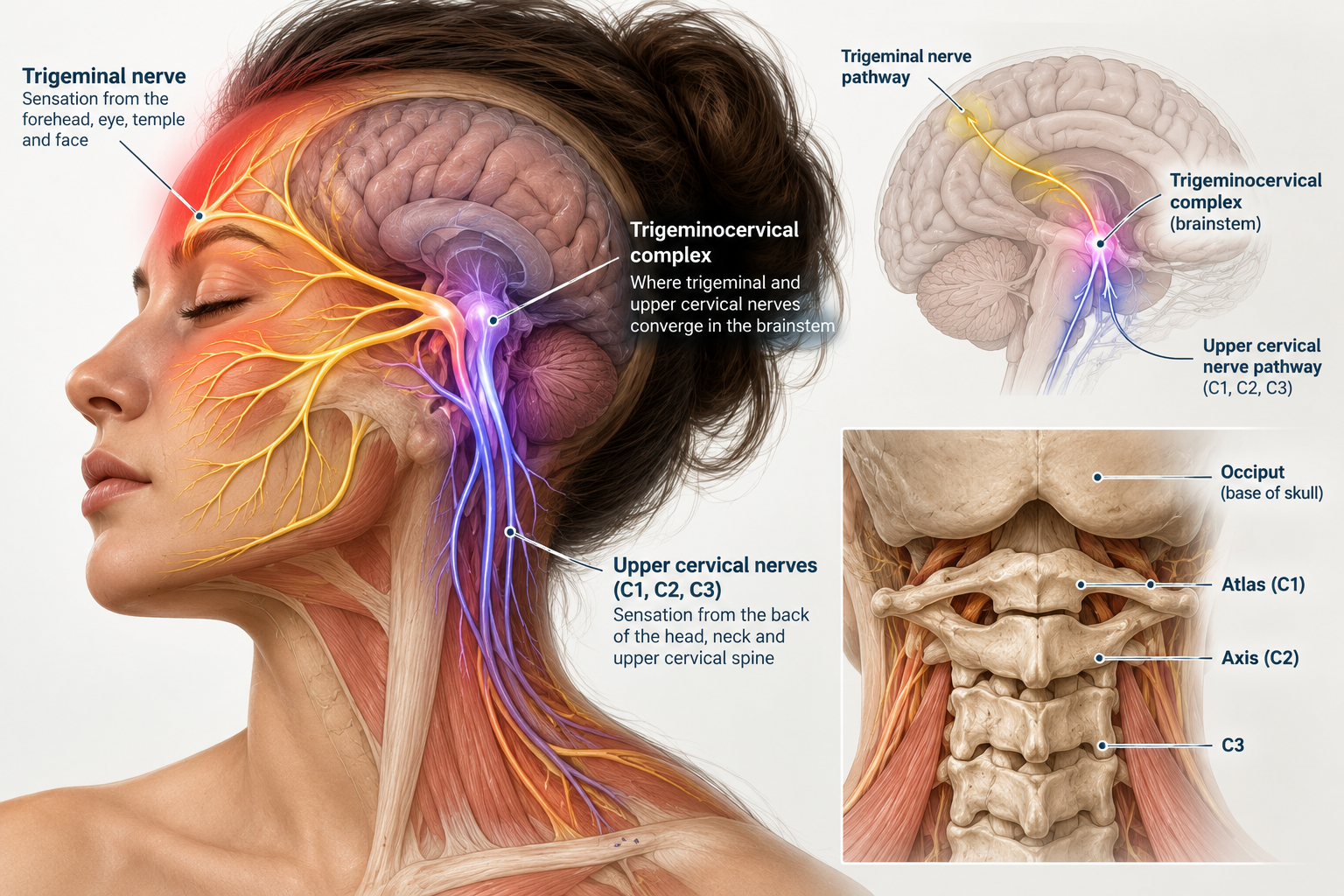
The Neck–Headache Connection
Why the Upper Neck Matters
The upper cervical spine is a unique neurological region. Sensory information from the upper cervical nerves interacts with pathways carrying sensation from the head and face through an area known as the trigeminocervical complex.
This connection helps explain why irritation or dysfunction involving structures in the upper neck can sometimes be experienced as pain in the head rather than simply as neck pain.
Headaches associated with the cervical spine are commonly referred to as cervicogenic headaches. They may be accompanied by neck pain or stiffness, restricted neck movement, pain beginning near the base of the skull, or symptoms aggravated by certain neck positions or movements.
Migraine is different. It is a complex neurological disorder and can involve much more than head pain. The presence of migraine does not mean that the neck is the cause of the condition.
The clinical question is whether dysfunction in the upper cervical region could be one contributing factor worth evaluating as part of the overall picture.
Video: Dr. Gordon Explains the Upper Neck–Headache Connection
A Different Approach to the Upper Cervical Spine
Where NUCCA Fits In
NUCCA focuses specifically on the relationship between the head and upper cervical spine — particularly the atlas (C1) and axis (C2).
Rather than assuming that a migraine or headache is coming from the neck, Dr. Gordon evaluates the upper cervical region for mechanical findings that may indicate this area should be considered as part of the clinical picture.
When appropriate, NUCCA uses a gentle, highly specific correction designed to improve upper cervical alignment and mechanics without twisting, cracking or forceful manipulation of the neck.
The question isn't simply:
“What kind of headache do I have?”
It may also be worth asking:
“Could my upper neck be contributing to my headaches?”
Book a Consultation →