TMJ & Jaw Pain · Calgary
Your Jaw May Not
Be the Whole
Problem
Jaw pain, tightness, clicking and difficulty opening your mouth naturally draw attention to the jaw itself. But your jaw doesn't function in isolation. It works as part of a closely coordinated system involving the jaw, skull, muscles of the head and neck, and cervical spine.
Dr. Cody Gordon looks beyond the painful joint to examine the relationship between the jaw, head and upper cervical spine — especially when TMJ symptoms keep returning despite treatment directed at the jaw.
Calgary, Alberta
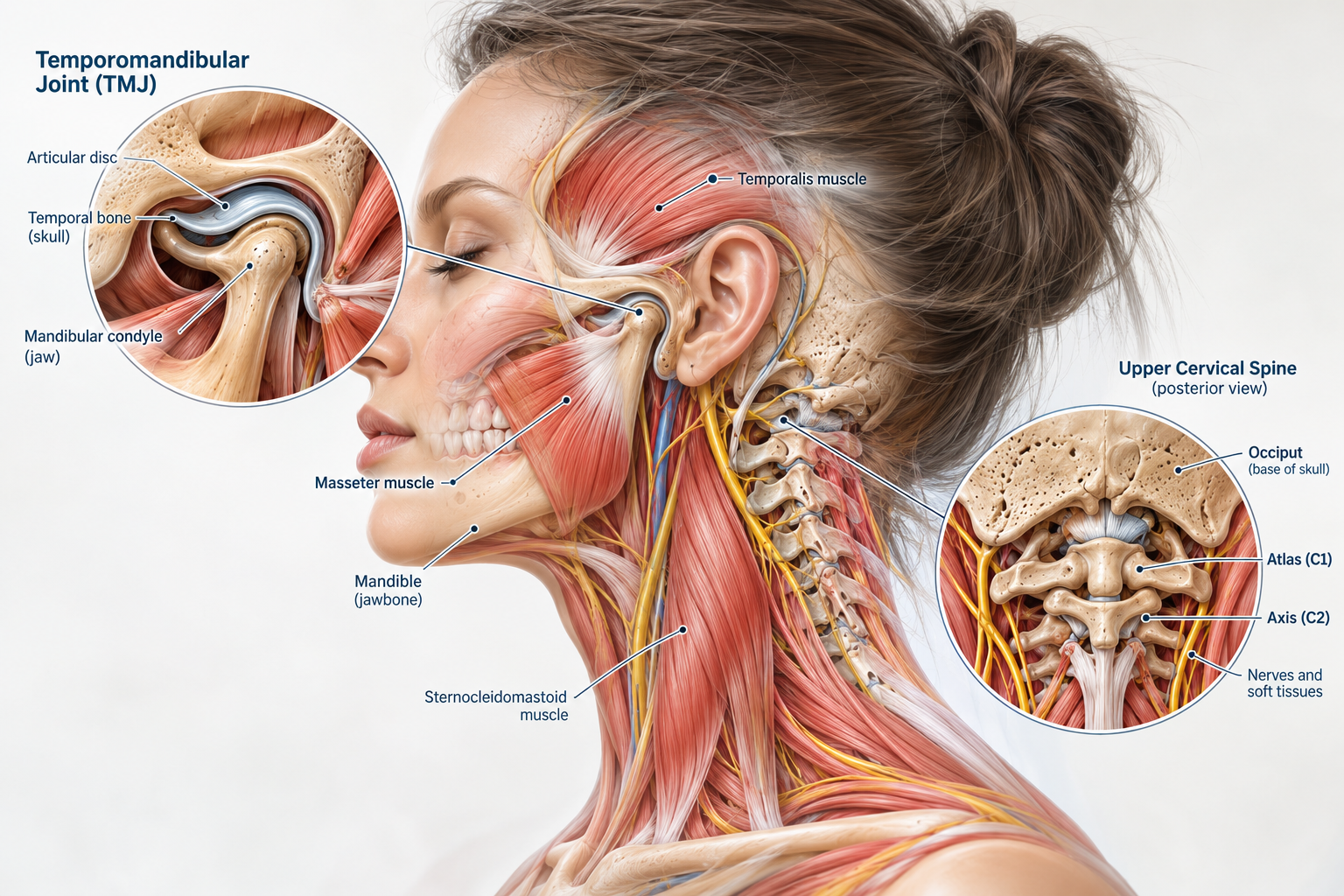
The Jaw–Neck Connection
Your Jaw and Neck Are More Connected Than You May Realize
When your jaw hurts, it's natural to focus on the jaw. But the temporomandibular joint doesn't work by itself.
Every time you talk, chew, swallow, clench or open your mouth, your jaw is functioning as part of a coordinated system involving the skull, muscles of the face and neck, and the cervical spine that supports the head.
That's one reason the relationship between TMJ problems and the cervical spine has become an important area of clinical research. People with temporomandibular disorders frequently also demonstrate neck pain or disability, changes in cervical movement and differences in how the muscles of the neck are functioning.
The upper cervical spine deserves particular attention. Directly beneath the skull, the occiput, atlas (C1) and axis (C2) help position and support the head while allowing a remarkable amount of movement.
The muscles controlling the jaw are working from a skull that is itself being supported and positioned by the neck. Jaw mechanics and head-and-neck mechanics are not completely separate systems.
This becomes especially interesting when someone has persistent jaw tension, pain, headaches or restricted opening despite repeatedly treating the jaw itself.
If treatment has focused almost entirely on your jaw, there may be another part of the picture that deserves a closer look.
Video: Dr. Gordon Explains the Connection Between the Jaw and Upper Neck
Looking Beyond the Jaw
Where the Upper Cervical Spine Fits In
For more than two decades, Dr. Cody Gordon has focused much of his clinical work on the relationship between the head and upper cervical spine.
When someone comes to his office with persistent TMJ or jaw complaints, one of the questions he wants to answer is whether dysfunction in the neck — particularly the upper cervical region — may be contributing to the larger mechanical picture.
That means looking beyond the painful joint.
Dr. Gordon evaluates how the head is positioned and supported, how the cervical spine is moving, and whether significant dysfunction exists in the relationship between the skull, atlas and axis.
When an upper cervical problem is identified, NUCCA provides a gentle, highly specific way of correcting this region without twisting or forceful manipulation of the neck.
The objective is to improve the alignment and mechanics of the upper cervical spine, reduce unnecessary mechanical stress and provide a better foundation for the head, neck and jaw to function together.
This can be particularly worth exploring when you've already spent considerable time treating the jaw but pain, tightness, clicking, headaches or restricted movement continue to return.
If you've spent most of your time treating your jaw, there's another question worth asking:
“Has anyone taken a really close look at the neck supporting it?”
A consultation with Dr. Gordon is an opportunity to have the relationship between your head, jaw and upper cervical spine looked at from a different perspective and determine whether upper cervical care may be an important part of your next step.
Book a Consultation →