Whiplash & Neck Injury · Calgary
The Accident May
Be Over. Your Neck
May Still Be Dealing
With It.
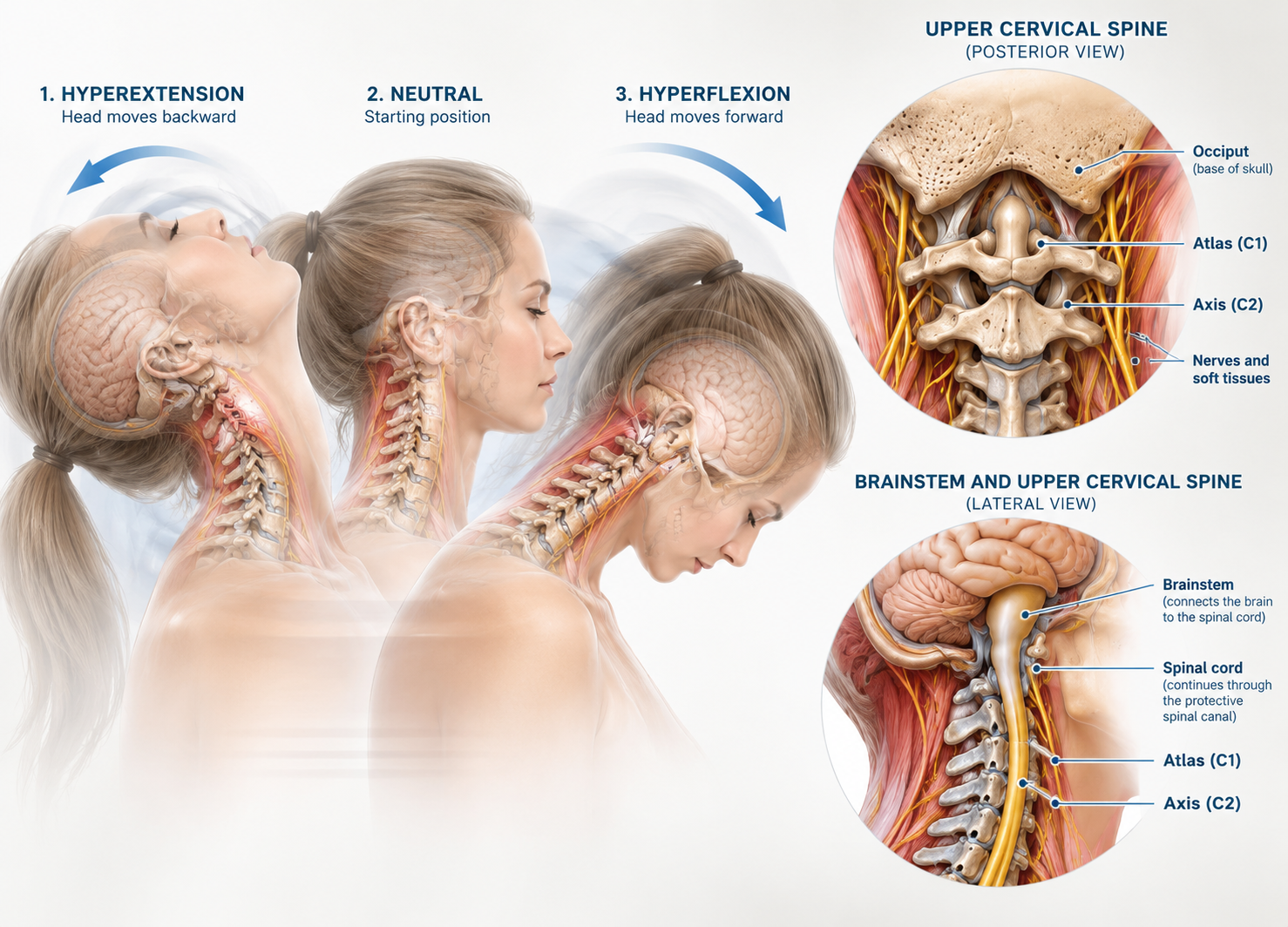
Whiplash happens in a fraction of a second. Rapid acceleration and deceleration of the head can place significant stress on the joints, muscles and supporting structures of the cervical spine.
When neck pain, headaches, stiffness, restricted movement or dizziness continue long after the original injury, Dr. Cody Gordon looks closely at the upper cervical spine — particularly the relationship between the skull, atlas (C1) and axis (C2) — for problems that may still be contributing.
Calgary, Alberta
When the Effects of an Injury Linger
Sometimes the Injury Is Old. The Problem Isn't.
The accident may have lasted only seconds. But for some people, their neck has simply never felt the same since.
Whiplash rapidly moves the head and neck through acceleration and deceleration. During that movement, the joints, muscles, ligaments and other supporting structures of the cervical spine are exposed to significant mechanical stress.
In the days that follow, pain and stiffness may seem like the obvious problem. But months or even years later, some people continue to experience recurring neck pain, headaches, restricted movement, muscle tension, dizziness or a persistent feeling that something in their neck just isn't right.
That's when it becomes important to look beyond where it hurts and ask a different question: Did the injury change the way the neck is functioning?
Dr. Gordon pays particular attention to the upper cervical spine. The occiput, atlas (C1) and axis (C2) form a unique mechanical region directly beneath the skull. These joints allow a remarkable amount of head movement and play an important role in how the head is supported and positioned over the rest of the spine.
When this region isn't functioning properly after an injury, the effects may extend beyond one sore muscle or one painful joint. The neck can develop patterns of restricted movement, muscular guarding and mechanical compensation as the body attempts to adapt.
If you've been saying, “My neck has never been the same since that accident,” there may be a reason worth investigating.
Video: Dr. Gordon Explains What Whiplash Can Do to the Upper Neck
A Different Way to Look at an Old Neck Injury
Why the Upper Cervical Spine Deserves a Closer Look
For more than two decades, Dr. Cody Gordon has focused much of his clinical work on the upper cervical spine and the relationship between the skull, atlas and axis.
His approach is different from simply finding the tightest muscle or treating the spot that hurts. He looks closely at the mechanics of the upper neck and the patterns that may have developed throughout the cervical spine following an injury.
This is where NUCCA offers something unique.
NUCCA is a highly specific upper cervical approach designed to evaluate the relationship between the head and upper neck and, when indicated, make a gentle and precise correction without twisting or forceful manipulation of the neck.
The goal is to improve alignment and mechanics in this critical region so that the neck has a better foundation from which to move, stabilize and function.
This can be especially important for someone who has spent months or years managing the symptoms of an old injury without ever having the upper cervical relationship examined in this way.
Sometimes an old injury has simply been accepted as something you'll have to live with. Dr. Gordon believes it's worth finding out whether there is still something there that can be addressed.
If your neck hasn't felt right since an accident, fall or collision, ask yourself:
“Has anyone ever looked this closely at what happened to my upper neck?”
A consultation with Dr. Gordon is an opportunity to tell the story of your injury, have the upper cervical spine carefully evaluated and find out whether a different approach could be worth exploring.
Book a Consultation →